




Testosterone cypionate and testosterone enanthate are nearly identical long-acting injectable forms of testosterone. While healthcare providers often consider them interchangeable, minor differences in their chemical structure affect how they are used and regional availability.
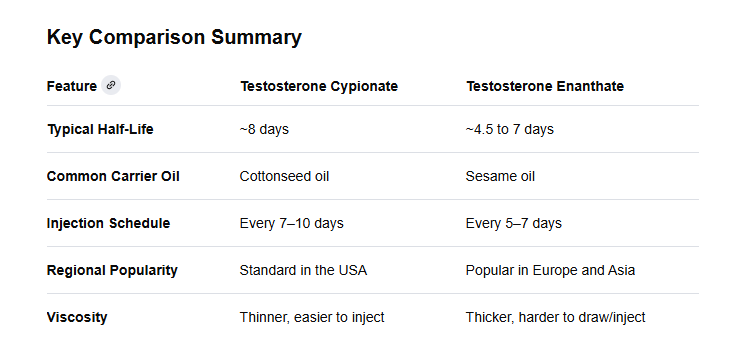
Primary DifferencesHalf-Life and Dosing: Cypionate has a slightly longer ester chain (8 carbons vs. 7 for enanthate), giving it a marginally longer half-life. This can allow for slightly less frequent injections compared to enanthate.
- Carrier Oils: The choice of carrier oil can cause localized reactions.Administration Routes: Both are traditionally injected intramuscularly (IM). However, cypionate is frequently prescribed for subcutaneous (Sub-Q) use, whereas enanthate is available as a specific FDA-approved subcutaneous autoinjector (Xyosted).
- Cypionate typically uses cottonseed oil, which is thinner and often easier to self-administer with smaller needles.
- Enanthate usually uses sesame oil, which is more viscous and may cause more localized pain or lumps at the injection site.
Differences in Ingredients
Testosterone cypionate (sold under the brand name Depo-Testosterone) and testosterone enanthate (sold under the brand name Xyosted and others) are modified forms of testosterone used primarily to treat male hypogonadism (low testosterone).
While similar in action, both have slight differences in their molecular structure—testosterone cypionate has eight carbon atoms while testosterone enanthate has seven—which affects how the drugs are absorbed and metabolized (broken down) by the body.23
The biggest difference is the carrier oil each is made with. This can affect the rate of absorption in tissues and how the drugs are administered.
Comparatively:
- Testosterone cypionate is made with cottonseed oil, which is thin, easier to draw and inject, and more readily absorbed after injection.2
- Testosterone enanthate is made with sesame oil, which is thicker, more difficult to draw and inject, and more likely to cause a temporary lump before absorption.3
Which Lasts Longer?
Differences in molecular structure also affect how quickly testosterone cypionate and testosterone enanthate are metabolized and remain active in the body. This is described by the drug half-life, meaning the time it takes for drug concentrations to drop by 50% after the initial dose.
Comparatively:
- Testosterone cypionate has a half-life of around eight days.4
- Testosterone enanthate has a half-life of around seven to nine days.5
This means that testosterone enanthate may stay in your system slightly longer than cypionate. Even so, the difference is relatively insignificant and usually doesn’t alter how either drug is used in hypogonadal males (testes produce little or no sex hormones).
Differences in Uses
One of the main differences between testosterone cypionate and testosterone enanthate is the range of conditions they are approved to treat, as determined by the U.S. Food and Drug Administration (FDA).
Testosterone cypionate is FDA-approved to treat:2
- Primary hypogonadism: This is a condition where the testicles do not make enough testosterone and other male hormones.
- Hypogonadotropic hypogonadism: This is a condition where the organs that regulate sex hormone production (called pituitary gland and hypothalamus) malfunction, causing testosterone levels to drop.
Testosterone enanthate is FDA-approved to treat a wider range of conditions, including:3
- Primary hypogonadism: Same as testosterone cypionate
- Hypogonadotropic hypogonadism: Same as testosterone cypionate
- Delayed puberty: This is an option for some boys who do not experience the expected body changes during puberty.
- Metastatic breast cancer: This is an option for some post-menopausal females who have inoperable breast cancer that has spread.
Differences in Dosage and Administration
Testosterone cypionate and testosterone enanthate not only differ by their approved uses but also by how they are administered and dosed. This includes the delivery of the drug by intramuscular injection (into a large muscle, typically the buttocks) or subcutaneous injection (under the skin, typically in the abdomen or thigh).
Testosterone cypionate is administered and dosed as follows:2
- Route of administration: Intramuscular or subcutaneous injection
- Dosage in hypogonadal males: 50 to 400 milligrams (mg) every two to four weeks
Testosterone enanthate is administered and dosed as follows:3
- Route of administration: Intramuscular or subcutaneous injection
- Dosage in hypogonadal males: Same as testosterone cypionate
- Dosage for delayed puberty: 50 to 200 mg every two to four weeks for around four to six months
- Dosage for metastatic breast cancer: 200 to 400 mg every two to four weeks
Post time: Dec-16-2025